Raja Rammohan Roy
In the early nineteenth century, many educated Indians began to feel that western culture and the rising tide of Christianity posed a challenge to their age old traditions and beliefs. In their attempt to remedy the situation, many reformers became critical of the past and began to look for ways to rid the society of its evils, such as caste distinction, purdah system and the custom of Sati. They wanted a new social order in keeping with the traditional values and modern development. Many Indians were impressed by progress made by science as well as the doctrine of reason and humanism of the West. The social conditions of the 19th century led to socio-religious reform movements. One of them was Brahmo Samaj.
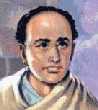
Raja Ram mohun Roy, founder of brahmo samaj
The Brahmo Samaj or the society of the God was founded in 1828 by Raja Rammohan Roy (1772-1833). He was a scholar and was well-versed in Sanskrit, Persian, English, Hindi and Bengali. He made an intensive study of Christianity and other religions. After that he came to the conclusion that the Hindu society needed reform and India had to learn a lot from the West.
Ram Mohan Roy was born in Burdwan in Bengal. Raja Rammohan Roy served the East India Company for a number of years and became a revenue officer in 1809. He was a critic of the unjust actions and policies of the British Government in India. He protested against the curbs on the freedom of the press. His progressive views helped to change Hindu society but these views were bitterly opposed by the orthodox Hindus. He was a social and religious reformer, an educationist and a political leader. He is remembered for his help in the abolition of Sati and in modernization of educational practices. His ideas on social and religious reforms constitute the ideals of the Brahmo Samaj founded by him in 1828.
Rabindranath Tagore said, "Raja Rammohan Roy inaugurated the modern age in India. He was the father of Indian Renaissance and the prophet of Indian nationalism." One of his greatest achievements is the uplift of the position of women in India. First of all, he tried to give women proper education in order to give them better social status in society. His effort in the abolition of Sati made him immortal as a social reformer.
Sati was an ancient Hindu custom, according to which a wife immolated herself at the funeral pyre of her husband. In 1811, Roy witnessed his brother's widow being burned alive on her husband's funeral pyre. Three years later, he retired and concentrated on campaigning against the practice of women dying as Satis. Raja Rammohan Roy was the first Indian to protest against this custom. In spite of protests from orthodox Hindus, he carried on his propoganda against the custom. Finally, he won the cause when Lord William Bentick, the Governor General of India passed a law in 1829 abolishing the custom of Sati. According to this law the custom of Sati became illegal and punishable as culpable homicide. Raja Rammohan Roy also opposed child-marriage and supported widow remarriage.
Raja Rammohan Roy supported Western education, including learning of English and the knowledge of science and philosophy. He, along with David Hare, a missionary, founded schools to impart English education to Indian children. He developed the Hindu College which finally developed into the Presidency College in Calcutta.
Raja Rammohan Roy did not want the Indians to imitate the West. He based his teachings on the philosophy of the Vedas and Upanishads and tried to bring about a synthesis of the Vedic religion and the Christian humanism. This very synthesis formed the basis of the Ramakrishna Math which was later formed by Swami Vivekananda. Raja Rammohan Roy focused the attention of the British Government to such demands as appointing Indians to higher posts. He protested against restrictions on the freedom of the press. His social reforms made him the "first modern man" in India.
Ideals of Brahmo Samaj
The ideals of Brahmo Samaj have their origin in the synthesis of the Vedic religion and the Christian humanism.
It advocated that there is one God, who is present everywhere, and is without shape and form. His worship lies in intense devotion.
It believed in the brotherhood of man and treated all men as equal. It started a magazine entitled Samvad Kaumudi, to teach people love of mankind.
It supported the introduction of English in schools with the belief that the study of English would open the door to modern sciences.
It condemned social evils such as casteism, untouchability, child marriage and the Sati system. It was due to the efforts of Raja Rammohan Roy that Lord William Bentick abolished Sati system in 1829 by declaring it an offence.
It advocated freedom of the press and condemned any restriction imposed on it by the Government.
It supported widow-remarriage and the education of girls. Raja Rammohan Roy was the first to agitate for getting women their rightful place.
In 1831, Roy visited the United Kingdom to speak on Indian questions. He died in Bristol in 1833. After the death of Raja Rammohan Roy, the work of the Brahmo Samaj was carried on by great men like Devender Nath Tagore (father of Rabindra Nath Tagore) and Keshab Chandra Sen. The Brahmo Samaj, besides reforming the Hindu society, heralded a new era of reform movements such as the Arya Samaj, the Ramakrishna Mission and the Prarthana Samaj (in Maharashtra).
William Bentick
Lord William Bentick, Governer-General from 1828-35, was the pilot mainly responsible for trimming the sails of the British Indian state to the wind of change. Bentick owed his appointment partly to his desire to wipe out the memory of his recall from the Madras governorship in 1807, partly to his connections (his father had been a Whig party Prime Minister of Britain), partly to the company's need of a strong hand to enforce economies and partly due to the unwillingness of others to go.
William Bentick
Bentick proceeded on a great northern tour and set in motion a new land revenue policy based on detailed surveys made on the spot. This, became the basis of north-Indian land administration during the British period. He reformed the judicial system creating two new grades of Indian judges. In 1828 he suppressed Sati or the burning of widows on the funeral pyres of their husbands.
In the Bengal presidency in the previous fifteen years recorded burnings only had varied from 500 to 850 annually. In orthodox theory this practice was a voluntary action on the part of the Hindu widow anxious to rejoin her god-husband through the purifying flames. She was Sati or devoted. In practice it was often induced by relatives ambitious for the prestige of Sati in the family, greedy of her property, or wanting one less mouth to feed. Raja Ram Mohan Roy had fought for a ban on Sati for past few years and had petitioned in various courts but successive Governor Generals were hesitant to take some action. Lord William Bentick acted and banned Sati and surprisingly faced little or no opposition from orthodox Hindus. His next move was the suppression of Thugee, or ritual murder and robbery in the name of Goddess Kali.
Bentick's next measures were more subtle and in the long run perhaps more far reaching. They amounted to planting western ideas and institutions on Indian soil and leaving them to grow as they would. The first field of activity was that of education.
English Education
Up to 1813 the company had followed the traditional pattern of governmental patronage to Indian learning. There was Warren Hastings college of Arabic and Persian studies in Calcutta and Jonathan Duncan's Sanskrit college in Benares. In 1813 the Charter Act sanctioned the annual sum of L 10,000 towards 'the revival and improvement of literature and the encouragement of the learned natives of India and for the introduction and promotion of a knowledge of the sciences among the inhabitants of the British territories of India'.
It was not until 1823 that a Committee of Public Instruction was formed to give effect to this provision. It immediately perceived the ambiguity between the promotion of oriental learning and the other western learning, and plunged into a lively controversy. This was the situation which Bentick found on his arrival and of which he took advantage.
In Calcutta he found a forward looking group of intellectuals led by Raja Ram Mohan Roy who had helped to found a college for western learning and advocated its introduction. In 1834 he received a powerful English reinforcement in the arrival of the Law member, Thomas Babington Macaulay. The result was the decision to launch English education and western knowledge into India. Macaulay declared in 1835 'that the great objects of the British government ought to be the promotion of European literature and science' and the available funds should 'be henceforth employed in imparting to the native population knowledge of English literature and science through the medium of the English language'.
From this time the government began to set up schools and colleges imparting western knowledge in the English language. To this was added another measure of greatest importance. English replaced Persian as the official state language and the medium of higher courts of law, local languages replacing Persian in the lower courts.
Western science was specifically introduced in the form of western medicine, of which the Calcutta Medical College was the first institution. Science also received attention in both schools and colleges. Western technology spread through engineering works like roads, canals, and later in 1853 by the introduction of Railways. The process was hastened by the increase in the number of Indian officers entering the administration as a result of Bentick's policy of Indianization.
Macaulay on his part started the codification of Indian public criminal law. The work was not completed until 1861 when the Indian Penal Code came into existence for the first time.
Bentick heralded a age of social & administrative reforms in India although no other Governor General after him went to the extent he went yet the after effects of his reformist attitude went a long way in providing mobility to the stagnant Indian society.
Ishwar Chandra Vidyasagar
In 1828, eight year old Ishwar Chandra Vidyasagar (1820-91) walked with his father, from the village of Birsingha in Midnapur district to Calcutta to seek admission in an English language institution. The fees at Hindu college were too high for his father to pay, so Ishwar Chandra Vidyasagar was enrolled in Sanskrit college. While studying in Calcutta, he lived at the home of a friend whose sister was a child widow. This was Ishwar Chandra Vidyasagar's first experience of the hardships this custom imposed on women. Sometime later, his old guru decided to marry a young girl.
Ishwar Chandra Vidyasagar was enraged and demonstrated his anger by refusing his guru's hospitality. Before a year had passed, the guru died and left behind a girl widow with nowhere to go and no means to support. Ishwar Chandra Vidyasagar vowed then to devote his life to improving the status of Hindu widows and encouraging re marriage.
Ishwar Chandra Vidyasagar also became an impassioned supporter of female education and an opponent of polygamy. He wrote lengthy tracts substantiating his position with scriptural citations and historical data. A decline in religion created the environment that allowed contemporary customs to thrive, he wrote.
When his opponents protested, he insisted they were misinterpreting scripture and employed a masterful command of Sanskrit to point out their ignorance. In his first tract on widow remarriage (1855) Ishwar Chandra Vidyasagar claimed that this practice was permissible in Kalyug (the dark age), the age in which he and his contemporaries lived. 2000 copies of this book was sold in first week, a reprint of 3000 soon sold out and the third reprint was of 10,000 copies. But not everyone was convinced. On the streets of Calcutta, Ishwar Chandra Vidyasagar found himself insulted, abused and even threatened with death.
Ishawara Chand Vidyasagar
Widow remarriage
But Vidyasagar pressed on and urged the British to pass legislation that will allow Hindu widows to remarry. To support his request, Ishwar Chandra Vidyasagar collected almost 1000 signatures and sent his petition to the Indian legislative council. The council received thousands of signatures for and against this measure but the members finally decided to support the enlightened minority, The Hindu widow remarriage act was passé in 1856. Although, the value of this act for improving the lives of woman has been questioned, one cannot doubt Ishwar Chandra Vidyasagar's desire to create a more humane society.
Vidyasagar lived in a world where the males among the Kulin Brahmins, an aristocratic caste with rigid marriage rules were highly sought after as bridegrooms and able to marry as many women as they wished. As Vidyasagar collected data on this custom, he became horrified by the magnitude of the problem. Using as a sample 133 Kulin Brahmins of Hooghly district, Ishwar Chandra Vidyasagar revealed the abuses inherent in polygamy. One fifty-year old man had married 107 times; Bholanath Bandopadhyaya (age fifty five) had eighty wives; Bhagaban Chattopadhyaya (age sixty-four) had seventy-two wives, and so the documentation continued. Arguing that the practice of Kulinism was inhuman, Ishwar Chandra Vidyasagar presented the government with a petition signed by 2,500 persons requesting the legislative prohibition of polygamy. No action was taken and ten years later he presented another petition signed by 21,000 persons requesting the legislative prohibition of polygamy. The government cautious after the 1857 mutiny, declined to act.
Vidyasagar continued his campaign and although he produced anti-polygamy tracts in 1871 and 1873, the issue was dead. Vidyasagar's third campaign focused on mass education for girls and boys. He had been appointed Special Inspector of Schools for the Districts of Hooghly, Midnapur, Burdman and Nadia and was able to use his influence to establish a system of vernacular education in Bengal, including forty schools for girls. J.E.D. Bethune, legal member of the Governor Generals council, had set up a girls school in 1849 and it became Vidyasagar's responsibility to guide it through its difficult years. He remained associated with it until 1869.
Despite this great man's efforts, widow remarriage never received the approval of the society, polygamy was not abolished, and the battle for female education had only begun.
Vidyasagar personified the best of the nineteenth century social reformers; arguing for social change he demonstrated as "untiring will for positive social action".
Click on this and try an interesting quiz on Indian History, will help you revise!


No comments:
Post a Comment